AbigailqC
Photography
Narrative Photographers
 1. Anne Leibovitz |  2. Keith Carter |  3. Rosemary Laing |
|---|
1. Anne Leibovitz
A reenact of Disney Dream Portraits was one of the many photographs Anne Leibovitz captured as it retells the story in a particular Disney movie. In this photograph, Anne captured the actress Scarlett Johansson as Cinderella to be the protagonist not only in the movie itself but also in this photo. Anne was not able to tell this without the use of techniques and photo elements. For a fairy like this image, there are some parts of the space that needs to be somewhat magical to establish that fantasy feel. The techniques that are applied in this image are, leading line, centre of interest/ focal point and the used of different colours.
The most obvious technique in this image is the leading line. The stairs played the main path to lead the viewers eyes to the protagonist, Cinderella. The horizontal lines of the stairs somehow connected to herself. She is standing in an area where the lines points out to give the importance of her. Within these leading lines, the viewers eyes also focuses on the castle in the background. The side lines of the end of the stairs are the ones that leads to the castle. Considering of having a lot of leading lines, this does not confuses the viewers eyes away form the centre of interest.
There can be one centre of interest in an image but as for narrative images, there can be two or more. Because the purpose of a narrative photography is to tell a story, these centre of interests helps to bring the story itself. In this image, the obvious centre of interest is Cinderella as she is the front. But as the viewers eyes go along the empty space, a glass sleeper and the castle also grabs their attention. The glass sleeper being shone y the line coming form the castle that also give the leading line.
The used of colours in this particular image has to fit on the part of the movie. In this image, viewers can see by watching the Disney movie, that Cinderella is running away from her prince when it hit midnight, meaning that the image has to be dark. Anne used a colour that relates to the night and also towards Cinderella, dark smoky blue. This colours gives the cold feeling through the nights she runs away. The colours itself reflects on what Cinderella is feeling inside that she is in a hurry and felt uneasy.
Overall, Anne Leibovitz told her narrative photo in a way that relates to the actual movie. With the use of techniques such as the leading lines, centre of interest and colours, she had created a grater meaning than the movie itself.
2. Keith Carter
Keith Carter’s photography style revolves on dreams and imagination, where objects of the mundane world open glimpses into ineffable realities. Carter makes photographs addressing the relationship we have to our ideas of place, time, memory, desire, and regret. He examines at times, the history of photography as well as our own shared histories. Carter’s photographs most seen in black and white format and often tells a whole range of emotions through each one. This photo of a young child and a crow is one of Carter’s photos that grabs the viewers attention. Two of the techniques in this photo are the centre of interest and the black and white colour.
In this photo the centre of interest lays in the middle of the frame, the crow. Because the image is black and white, the white part are simply the empty space and is occupied by the black space. With this reason, the centre of interest is in easily by the blank white space. In the frame, you can see that there is a child and a crow which seem to be put together to be focused. It is possible that this photo has two centre of interest due to the used of colour. There are blurry and focused part in the image and the most obvious part is in the middle where the two objects placed.
Black and White is the biggest part of Carter’s Photography where it shows all the importance of emotion and imagination. In this image, the emotion is the one that captures the viewers attention by the help of used shades. Black and white is one of the technique to tell the dark side of a photo and in this photo, it has showed the whole of it. The young child is in a horror facing the crow as the side of the frame blur to represent confusion. This image also shows the imagination of the place due to the foggy white space in the photo.
Overall, Cater use black and white as his main theme for this photo as it contributes to the emotion and imagination factor of the photo. Not only this, Carter also delivered the final result to have a meaningful story.
3. Rosemary Laing
Rosemary Laing is a photo-based artist. Her projects are most often created in relation to cultural and/or historically resonant locations throughout Australia. With interventions undertaken in situ or through the use of choreographed performance work, she engages with the politics of place and contemporary culture. In this particular image, the creativity side of Laing is shown as she create an impossible situation of making the girl float in the air. The techniques she uses to tell the story are the used of colours and the centre of interest.
Laing used a whole range of colours for what seemed to be paper floating in the air. The colours of the paper blended well in the background where it is white and plain. These colours help to tell the narrative of the image. Combined together, it creates a some kind of commotion.The colour white represent as the steady and stable act as the paper represents the challenges the character went through. It can also mean that the hardship of the character is going through got her into pieces, represented by all kinds of paper falling. The colours can always mean different things for as it can always represent a different thing to another by the subjects in the photo.
The centre of interest in this photo is obviously in the middle of the frame, the girl. The girl is the focal point of the image for as she is a big subject compared to the background the the fallen pieces. Even if all the paper are floating all over the space, Laing successfully captured the centre of the interest to catch the viewers attention. The centre of interest is also one of the biggest part in this photo because it is the one that tells the story.
Overall, Laing’s image also represents a narrative type of photography. It is full of symbols and meanings through the use of colours and the technique of centre of interest.
Story Board

1. Luggage on the floor, the sign of someone leaving.
The luggage would be placed on the floor where I take a low angle shot and possible have one character in the background to explain the whole point of the image.
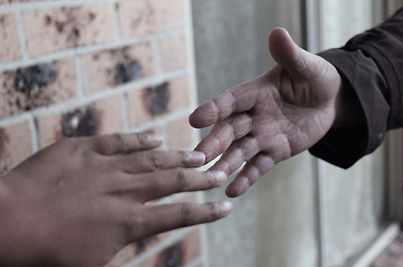
2. Close up of two Hands saying goodbye.
The hands will be on close up and focused where the attention of the viewers lays in it. This is to show that the characters are finally saying goodbye to each other.
3. Close up of the character's eyes, showing the loneliness looking out the window.
The eyes of the character will be closed up and focused as it shows a deep meaning of loneliness by the window glass.
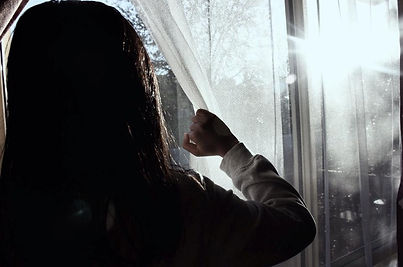
4. Standing by the window, waiting. (normal day)
The character will standing by the window, grabbing the curtain and stares outside, This will be taken in a normal day light.
5. Leaning against the window, waiting. (sunset)
The character will be leaning her head against the window to show the sad feeling. This will be taken with a sunrise ligthing.
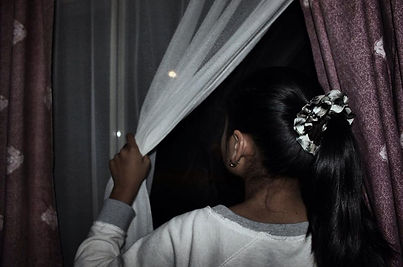
6. Standing by the window, opened the curtain (night)
The character will be standing by the suring night time.
7. Hands on the window galss, waiting (rainy)
The character will have her hands on the window glass meaning that she wants to be wehere she wants. This will be taken in a rainy day.
8. Waiting at the front door, looked through the blinds.
The character will be looking through the blinds at the door. This will show how much she needs someone.
9. Door handle opening, sign for someone to come in.
This will be a photo of a door handle showing that someone is going to come in which is the other chracter that she has been waiting for.
10. Characters reunited while hugging each other (over view of the door as it shows someone is finally home)
The two characters reunite showing that the wait is over and a happy but emotional ending.
Idea Process
The idea of how I'm going to take my pictures will be based on what my story will be about. In the beginning, I will have to show that someone is leaving. As the story goes on, the character that is left (daughter) will have to wait for the other character (mother) to come back home. In this idea, I will have to take around six photos showing the days that passed. Within this, I will arrange different day lighting from the natural light outside my house. Some of the lightings will be, normal sunny day, sunrise, night, foggy, rainy and the day the character comes back, the natural light of the day. This idea will be related to the actual or similar to create that final Tell in Ten photos.
Tell in Ten "Story"
Before
After








Tell In Ten Final

Process
The Storyline:
1. The story of my tell in ten is about the relationship of mother and daughter. The story is based on a mother (my mum) moving away to look for a job in a different country while the daughter (my sister) waits fro her day by day until they reunite in the end. I came up with this for as I am proud of all the parents that sacrifices to work alone in a different country away from their love ones. This has inspired me because I have seen this a lot from the country I’m from, the Philippines. And with that, I can't really interpret the true emotions of the family going through long distance but I have tired to explain it by my own understanding of how it would feel for me. Within that, I have used and edited a my images to darker colour to show the loneliness of the characters and the sad and heart warming concept in the whole story.
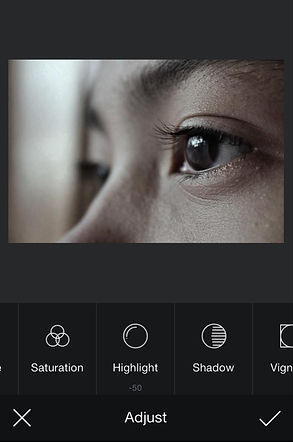
2. For editing, I took my originally taken photos and only change one thing throughout the whole process, that is to change the highlight to low -50. For this editing, I did not used photoshop to edit it as it didn't have the right shade of colour that will suit the story. By turning it all to black and white it wont have the a very effective effect as my story is about how time passes by. With the natural lightings I used, I wanted to show the colours to develope my story throughout the theme of my story which is to show the colour changing of the day. By just putting my images in low lighting, it has made them more meaningful and emotional. This technique can tell a lot more to the story as dark and light colours pops up. Just like the black and white photos, it is successful towards the sad and dark concept like my story. Even the story ends happy when the characters reunite, the colours still in a smooth dark because the emotion of relief and secured are still there.
The techniques that I've used to tell my story are the centre of interest, camera angle and used of colours.
The centre of interest in each of my photographs are one of the biggest techniques to tell the story. In each one, there is always a centre of interest that captures the viewers attention. It is centred in the part of the frame or is focused in the side. The camera angle is also used in my photos, the eye level, low level and close up. The eye level is the most used in my narrative story. There are six photos that represents this camera angle. The next one is the low angle, where I placed the camera in a low angle especially in the fifth photo. This technique is used to symbolises the loneliness of the character when she is leaning against the window. The last angle is the close up where the camera is focused close in the characters. This is used in 3 of the photos focusing in the centre of interest. The third photo is specially shot closed up to create a deeper meaning in the eyes. Lastly, the colour effect that was used to tell the whole concept of the story, sad. This colour helps to compete the whole look of each and everyone of the images.
Final Product
1. The ten images of the narrative story was pretty successful due to the process I followed. It went on way I wanted too even when the set was not quite on point. The final ued to tell my story based on the concept I was aiming for. It created a deep meaning due to the techniques I used and it developed throughout the whole story.
2. Out of the ten images I captured, the most successful one is the fifth one where the character is placed in low angle. It is most sucessful beacsue it meets all the requirements tbased on the story, the sad and lonely feeling. Within this particular image, the colours are the higlight as it brings that warm but also cold feeling to the viewers eyes. The sunset in the background not nly brings the warm factor but it also creates the magical set in the phto. By adding the final colour effect, the whole mage sense with its techniques put together.
3. The least sucessful out of the ten images is the first one where the story begins. In a point of view, a story may start strong and for my story it could have started meaningful. It could have started as a symbol that the character is leaving to create the deeper meaning and purpose of the image.
4. Overall, the format was successful in the end where it was all combined together to tell the story. Where it using the same feeling in each images presented to be assured that there is a certain theme and concept.
Evidence of the Editing (ScreenShots)
For all my ten images, I only used one effect, which is to lower the highlight to -50. These are some example form my photos.